.png?width=120&height=32&name=Lunit%20Logo%20(Black).png "Lunit Logo (Black)")
Performance of AI when replacing one reader in a double-reading setting for breast cancer screening
This page presents real-world clinical results of using the Lunit artificial intelligence as a second reader in double-reading breast cancer screening, based on operational experience at Capio S:t Göran Hospital and presented by Dr. Karin Dembrower at the Annual Congress of the European Society of Breast Imaging 2024.
Experience from a screening program using Lunit AI in routine practice:
🎙️ Speaker: Dr. Karin Dembrower
Head Physician, Department of Breast Radiology, Capio S:t Göran Hospital, Sweden
Key outcomes after one year of AI implementation:
-
15% increase in cancer detection rates
-
11% decrease in recall rates
-
31% increase in Positive Predictive Value
-
36% reduction in reading time, allowing radiologists to focus more on complex cases
Results observed when using AI as an independent second reader in routine clinical practice.
Outcomes may vary depending on clinical setting and workflow.
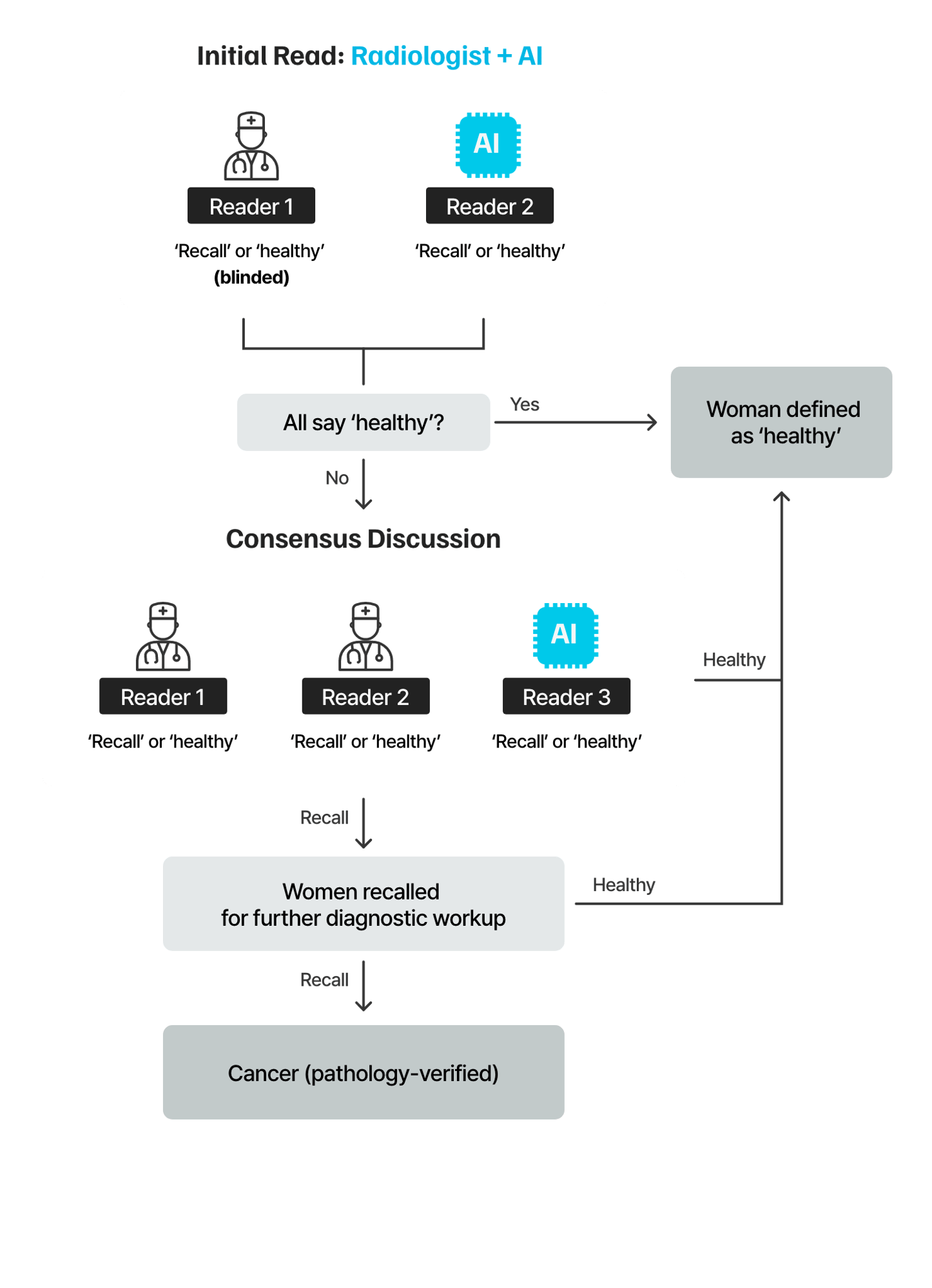
Evidence behind the AI adoption
In her EUSOBI presentation, Dr. Dembrower presents the impacts of implementing Lunit INSIGHT MMG on the St Goran Hospital's breast cancer screening program's metrics. The decision to implement Lunit INSIGHT MMG was informed by the ScreenTrustCAD prospective study, which evaluated whether AI can safely replace the second human reader in routine breast cancer screening.
Read the ScreenTrustCAD study: learn how AI was assessed as a replacement for the second reader and how the study informed clinical deployment.